

Case Study: How a Multi-Site Construction Client Recovered Nearly $129,000
Industry: Construction
A multi-site construction client cut fuel cost, recovered field labor, and lowered maintenance drag by moving job site fueling to a smarter model.
The setup
A construction client running job sites across North Texas and Oklahoma called Fuel Logic because equipment needed fuel now, not eventually. The sites weren’t sitting off one central yard. Equipment moved, crews moved, and retail fuel access out where the work actually happened was limited at best.
The relationship started with one site. Once that site showed what a better fueling model could do, the client brought Fuel Logic into additional locations.
This wasn’t a story about a fleet parked in one lot every night. It was about job site complexity: equipment needs shifting by project phase, terrain, and how far the nearest retail pump actually was. The company didn’t need cheaper fuel so much as it needed fuel that showed up without pulling a crew off the job to go find it.
What the old setup was actually costing
Before Fuel Logic, the client was running about 170,000 gallons a year at an effective cost of $4.22 a gallon, for a total annual spend of $717,400. Market rack price at the time sat closer to $3.60 a gallon. That gap, about $0.30 a gallon, meant roughly $51,000 a year was avoidable through a better structure. Same fuel, same equipment, just a worse way of getting it there.
But the per-gallon number was only half the story. Remote job sites don’t forgive small fueling problems the way a yard does. If a machine sits idle waiting on fuel, the crew waits with it. If someone has to leave the site to go find diesel, that’s labor and equipment sitting still at the same time. None of that shows up on a fuel invoice. It shows up in the schedule.
Matching the fuel to the job, not the other way around
Some of this client’s fuel demand was predictable enough to put on a schedule. Other equipment and crews moved between sites in ways that still needed flexibility. Forcing everything onto one model, fully mobile or fully card-based, would have solved half the problem and made the other half worse.
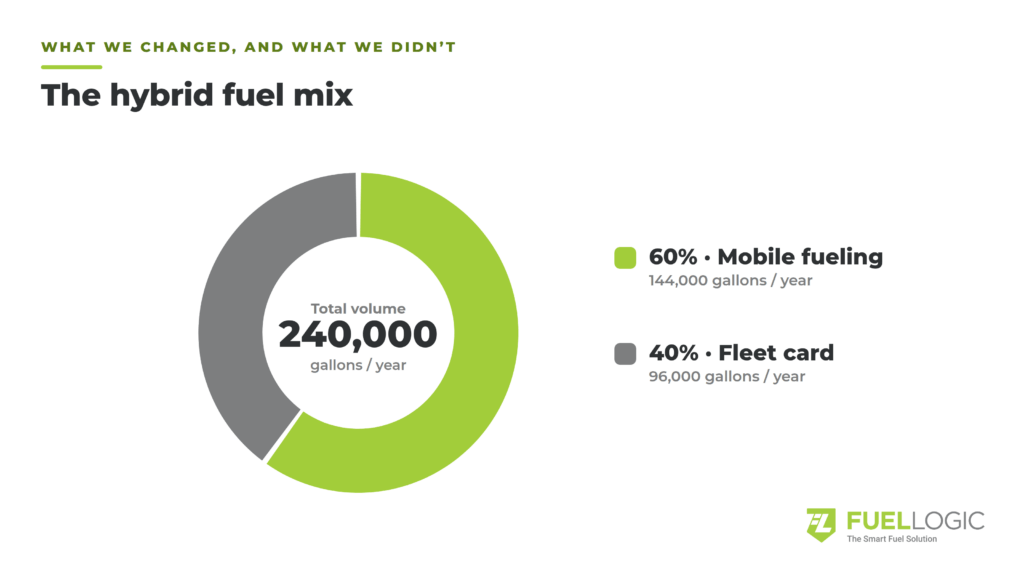
So we split it. Fuel Logic moved 100,000 gallons a year to scheduled mobile delivery, fueling equipment directly on-site, at about $3.65 a gallon. The remaining 70,000 gallons stayed on fleet cards, at about $3.75 a gallon, for the situations that still needed that flexibility.
- Mobile fueling: 100,000 gallons × $3.65 = $365,000
- Fleet card usage: 70,000 gallons × $3.75 = $262,500
- New annual fuel spend: $627,500
Against the old $717,400, that’s $89,900 in direct annual savings. That number alone would have made the switch worth it. It wasn’t even the biggest piece.
The maintenance angle most fuel comparisons skip
There’s a detail about diesel that most fleets never think about: where it came from matters. Fuel straight from the refinery is cleaned of impurities under tightly controlled conditions and leaves that process chemically consistent. Diesel sitting at the bottom of a retail tank has usually traveled through pipelines, storage tanks, and delivery trucks along the way, and picked up a little water, dirt, or old tank sediment somewhere in that trip. None of that is dramatic on its own. Across enough gallons and enough equipment, it adds up to more filter changes, more fuel system issues, more downtime nobody planned for.
Cleaner, more consistent fuel handling was part of what drove an estimated $15,000 a year in reduced maintenance costs for this client, on top of everything else the new structure fixed.
The labor side of the math
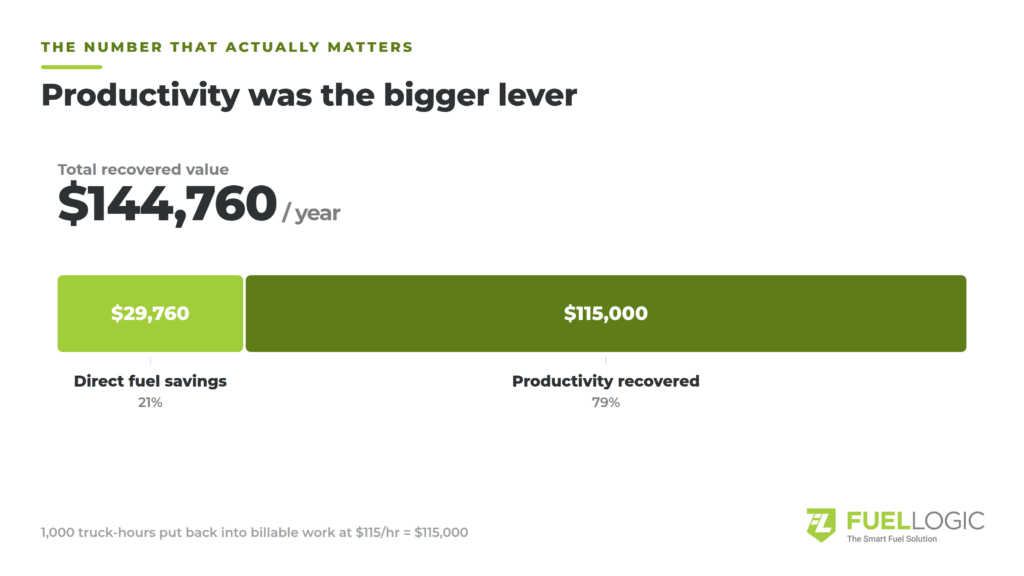
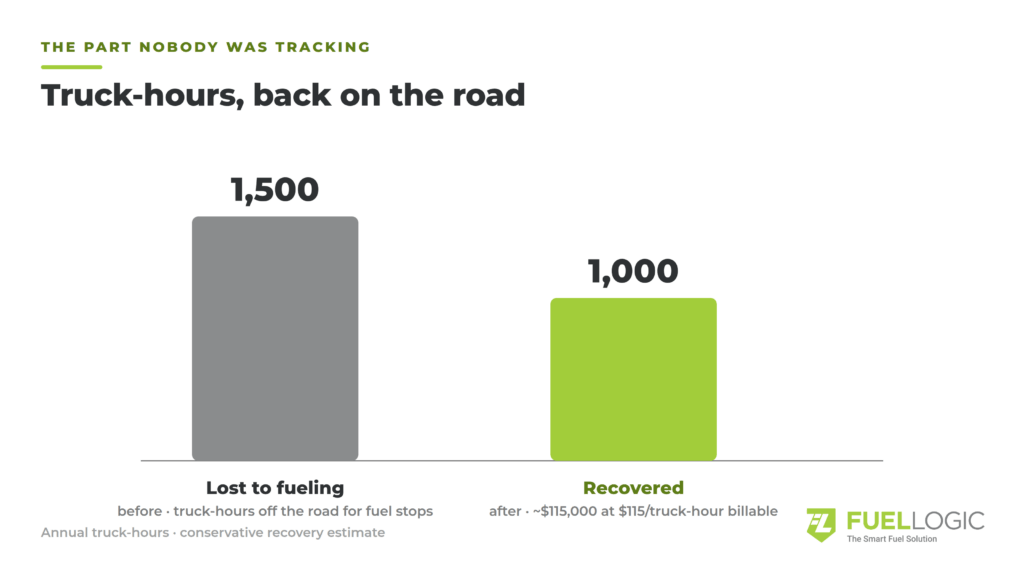
Moving 100,000 gallons to scheduled, on-site delivery meant field crews stopped losing time coordinating fuel runs or waiting on equipment that couldn’t work without it. Fuel Logic estimated the new model recovered about 576 labor hours a year. At an estimated $42 an hour, that’s $24,192 in recovered productivity value.
Add it all up:
$89,900 direct fuel savings + $24,192 productivity value + $15,000 maintenance reduction = $129,092 in total annual impact
What actually changed
The client didn’t need every gallon delivered, and didn’t need every gallon running through a card either. What it needed was a structure that put predictable, high-volume job site fuel on a schedule and left the card in place for whatever still needed to move around. That combination is what got the savings, the recovered labor, and the lower maintenance drag all at once.
Over time, the client moved even further in that direction. Today the account runs on fully scheduled fuel delivery rather than the original card-and-mobile split, a sign of how much more predictable the fueling need became once it was actually being managed instead of chased.
The lesson here isn’t “go mobile” or “keep your cards.” It’s that remote job sites punish whatever fueling model doesn’t match how the work actually happens. Get that match right, and the savings follow on their own.
Key takeaways
One partner replaced 40 different vendors.
A fragmented, site-by-site vendor network became a single accountable relationship across the company’s entire footprint.
Different sites, one consistent process.
Recurring schedules, on-request delivery, dyed diesel, DEF, whatever a site actually needed stayed intact, without every location running its own separate vendor relationship to get it.
Emergency fuel became the exception, not the routine.
What used to be a regular fire drill now mostly shows up only when a new site is still getting stabilized.
Billing and communication got simpler, not just cheaper.
Fewer invoice formats, fewer inconsistent vendors, less time spent reconciling and chasing people down.
The program could grow without adding complexity.
New sites came on board without adding another vendor relationship to manage.
Ready to simplify fuel across your own footprint?
If your team is managing fuel site by site, with a different vendor for every location, that’s not a fuel problem. It’s a management problem, and it’s fixable. Talk to Fuel Logic about bringing your locations under one accountable partner.